
IBD Injection-Site Reactions: What Is Common and What Deserves a Call
By the Aidy Editorial Team
First Published Jun 24, 2026Last Updated Aug 4, 2026
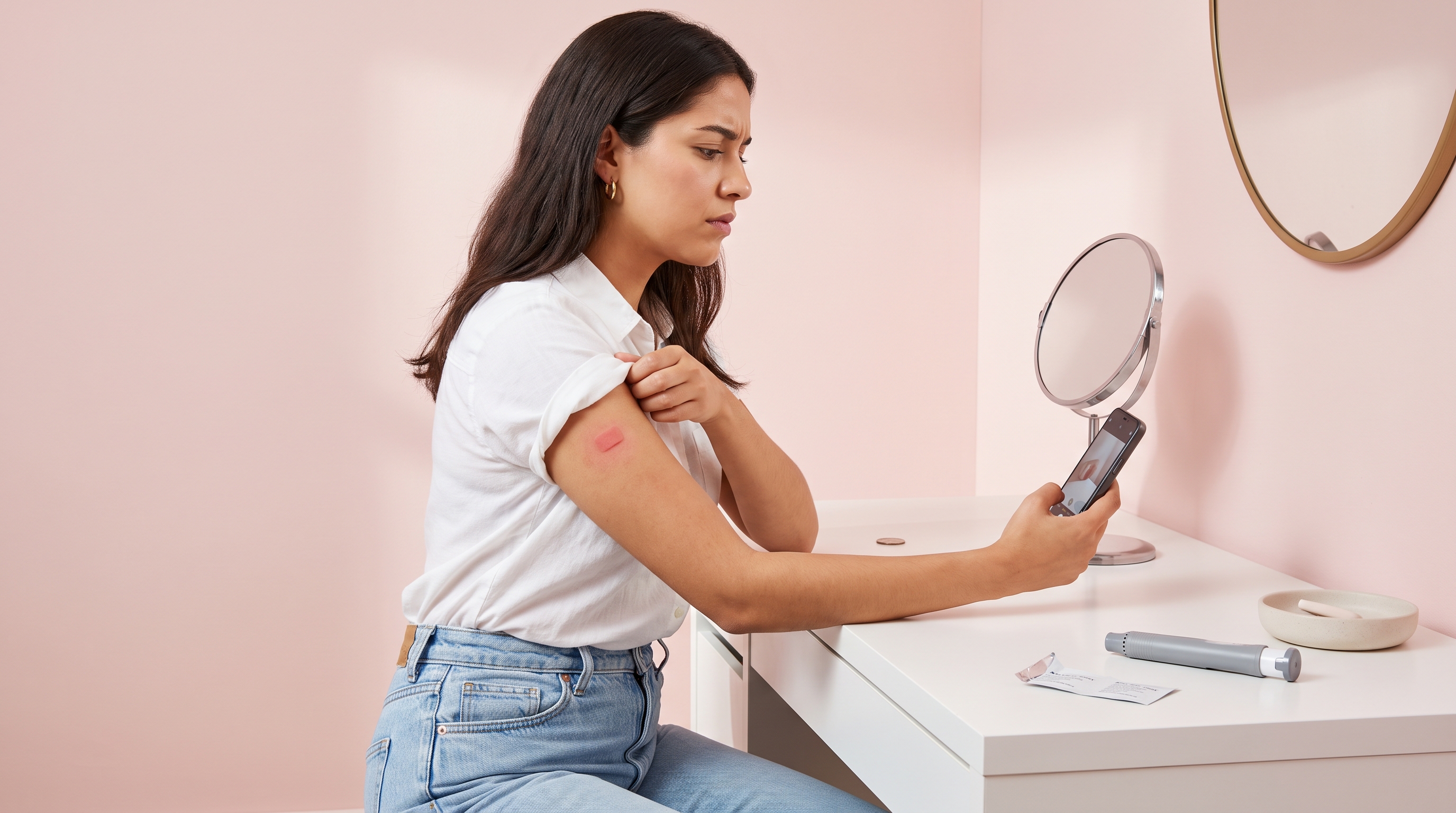
A red, itchy, slightly swollen patch where you just injected your biologic is one of the most common things patients report after starting self-injection therapy for Crohn's disease or ulcerative colitis. It is also one of the hardest things to judge alone at home, because the same three symptoms of redness, swelling, and pain appear both in harmless local irritation and in the early stage of a skin infection. Knowing what the drug labels and published trials actually describe as expected, and which specific features move a reaction into call-your-team or call-911 territory, makes that judgment much easier.
What a typical injection site reaction looks like
Drug labels use a narrow vocabulary for these events. The HUMIRA prescribing information defines an injection site reaction as erythema, meaning redness, and/or itching, hemorrhage, pain or swelling, and notes that most were described as mild and generally did not require stopping the drug. A systematic review and meta-analysis of injection site reactions across 158 randomized trials of 16 biologic agents found erythema was the most frequently recorded type at 42.8% of reported reactions, followed by unspecified reactions at 23.3%, pain at 12.4%, and pruritus, or itching, at 5.7%. In 39 of the 48 studies that tracked it, no patient stopped treatment because of an injection site reaction. Dermatology literature places the overall incidence of injection site reactions with biologics between 0.5% and 40% depending on the specific medication, and describes most as irritative rather than allergic.
How often reactions happen with common IBD biologics
Rates differ substantially between drugs, which is worth knowing if you are comparing your experience to someone else's. In placebo-controlled trials, 20% of people treated with adalimumab developed an injection site reaction compared with 14% on placebo. Subcutaneous vedolizumab produced injection site reactions in 10% of patients in the ulcerative colitis trial and 3% in the Crohn's disease trial, including erythema, rash, pruritus, swelling, bruising, urticaria, pain, and edema. Mirikizumab reported injection site reactions in 9% of ulcerative colitis maintenance patients versus 4% on placebo, and 10% versus 4% in Crohn's disease. Risankizumab maintenance showed rates of 4.5% and 5.6% in Crohn's disease and roughly 2.9% in ulcerative colitis, against 2.8% and 1.2% on placebo. Ustekinumab maintenance in Crohn's disease recorded injection site erythema in 5% of treated patients and none on placebo.
When an injection site reaction deserves a call
Three patterns should prompt a message or call to your prescribing team rather than watchful waiting. The first is anything that looks like a spreading skin infection. Cellulitis presents with redness that gets bigger as the infection spreads, warm skin over the red area, and fever with chills and sweating, and the guidance is to seek care immediately for persistent fever, drowsiness, blistering over the reddened area, or red streaks spreading outward. A local reaction that is warm and expanding a day or two after injection, especially with any fever, is not something to sit on.
The second pattern is escalation. When a reaction arrives faster and hits harder with each successive dose, that increasing intensity and rapid onset with successive injections suggests an immune-mediated mechanism rather than simple irritation, and it is worth an evaluation before the next scheduled dose. The third is any reaction severe enough that you are considering skipping or delaying a dose. That decision belongs with your gastroenterology team, because gaps in biologic dosing carry their own risk.
Symptoms that call for emergency care rather than a phone call
Systemic allergic reactions are a different category from anything happening in the skin at the injection site, and they are handled as emergencies. Serious hypersensitivity reactions, including anaphylaxis and angioedema, have been reported with ustekinumab in trials and after marketing, in one pediatric case within the first two minutes of an infusion. The certolizumab pegol label lists angioedema, anaphylaxis, dyspnea, hypotension, rash, serum sickness, and urticaria as reported hypersensitivity symptoms. The mirikizumab labeling instructs patients to seek emergency help for throat swelling, breathing difficulty, chest tightness, rapid heartbeat, or widespread hives and itching. Anaphylaxis is rare with these drugs, with one case among 1,434 patients treated with intravenous vedolizumab, or 0.07%, but rarity does not change the response. Hives spreading well beyond the injection site, swelling of the lips, tongue, or throat, wheezing, difficulty breathing, or lightheadedness after a dose mean emergency services, not a voicemail.
What to document so your team can see the pattern
A single description from memory tells a prescriber very little. A dated record across several doses tells them a great deal. For each reaction, capture the date and time of injection, which drug and dose, the exact anatomical site used, and how long after the injection symptoms began. Photograph the area in consistent lighting with something for scale, such as a coin or ruler, and note the approximate diameter of redness. Record how long the reaction lasted and whether it was larger, faster, or more painful than the previous one. That last comparison is the single most useful piece of information, because escalation across doses is the feature that separates routine irritation from a reaction that needs formal evaluation.
Reducing injection site reactions
Technique changes help with the irritative reactions that account for most of what patients experience. Adalimumab labeling advises that the product can be taken out of the refrigerator for 15 to 30 minutes before injecting to reach room temperature, and instructs patients to rotate sites in the thigh or abdomen and to avoid injecting where the skin is tender, bruised, red, or hard. Formulation matters as well. In a study of pediatric inflammatory bowel disease patients, 95% rated their pain above 3 on a 10-point scale with the original adalimumab formulation compared with 5% using the citrate-free version. A broader systematic review of citrate-free versus citrate-containing biologics reached the same direction of effect, concluding that subcutaneous administration without citrate may be associated with lower injection pain. If pain is driving you toward missed doses, ask whether a citrate-free product or a different device is available.
Most injection site reactions in inflammatory bowel disease are local, mild, and self-limited, and the trial data show they seldom force a change in therapy. The reactions worth escalating are the ones that spread with warmth and fever, the ones that grow worse with each dose, and any symptom that leaves the skin and becomes systemic. Keeping a photographed, dated record of what happens after each injection turns a vague worry into something a prescribing team can evaluate quickly, and it makes the difference between guessing and knowing when the next dose comes due.
This article is for educational purposes and is not medical advice. It is researched against current AGA clinical guidelines and peer-reviewed sources. Always discuss treatment decisions with your care team.