
How to Pack an IBD Travel Medication Record
By the Aidy Editorial Team
First Published Jun 3, 2026Last Updated Aug 4, 2026
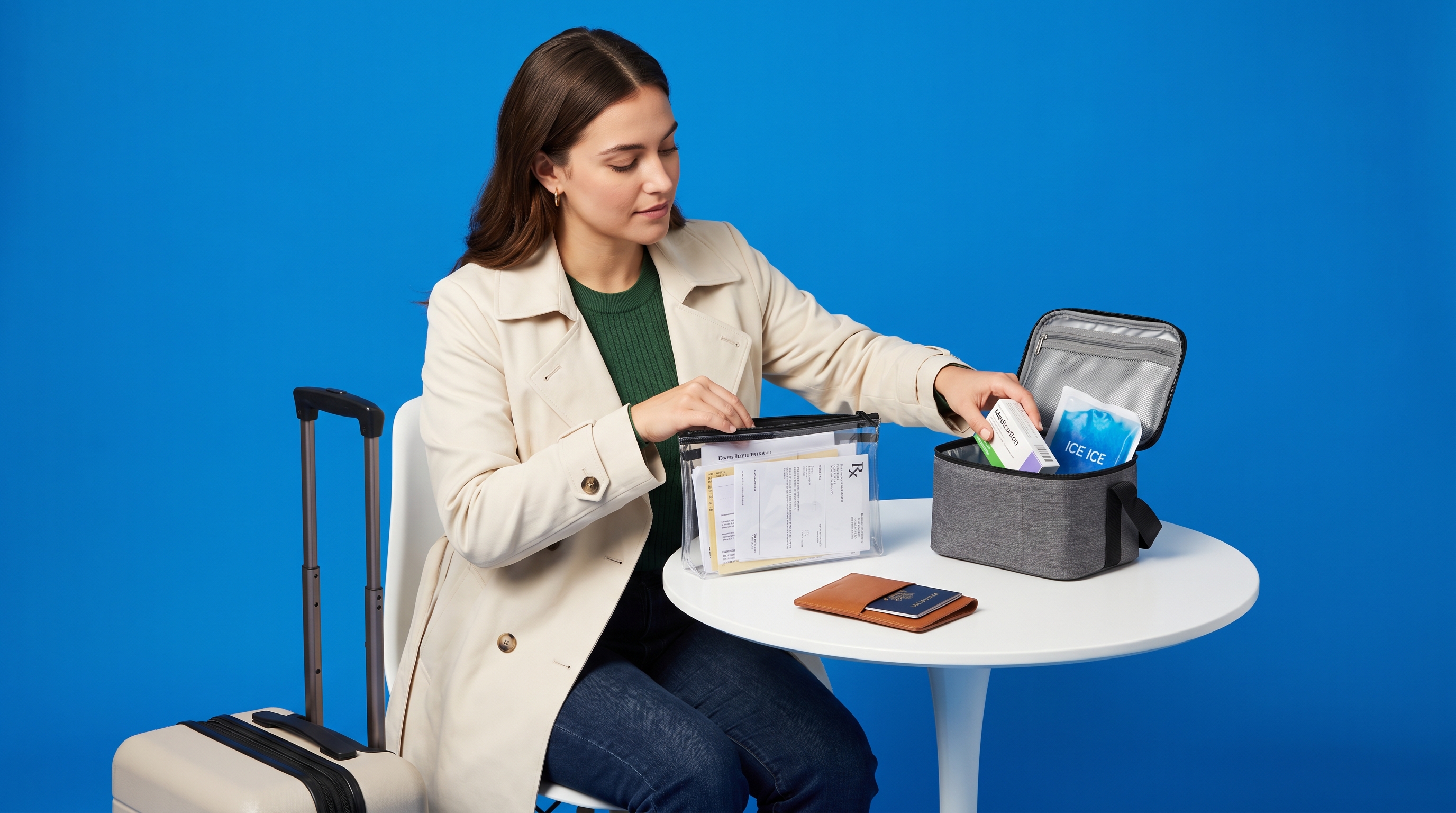
A travel medication record is a single document that gathers everything a security officer, pharmacist, or emergency clinician might need to understand your inflammatory bowel disease treatment while you are away from home. For people living with Crohn's disease, that treatment often includes injectable biologics, immunomodulators, and supporting drugs that raise practical questions at airport checkpoints and international borders. Building the record before you leave gives any provider you see on the road a clear picture of your care. This guide walks through what to carry, how to organize it, and the rules that govern medications in transit.
What Belongs in a Travel Medication Record
The core of the record is a complete medication list. The Crohn's & Colitis Foundation advises travelers to make copies of all prescriptions, including foreign brand names or generic names, which matters because a drug sold under one trade name at home may appear under a different name abroad. The CDC reinforces this by recommending a medical summary stating diagnoses, regular medications listed by generic rather than trade name, and allergies in case you need care during the trip.
Alongside the list, include a short statement of your diagnosis and current treatment plan. A record that names your condition, the biologic or immunomodulator you take, and your dosing interval lets a clinician who has never met you act quickly. Keep this documentation with the medications themselves, since the CDC recommends storing such a kit in a water-resistant container that stays readily accessible during the journey.
Documenting Doses, Schedules, and Clinician Contacts
A medication card for travel should record more than drug names. For each medication, note the strength, how much you take, how often, and the route of administration. The CDC template letter for travelers captures exactly these fields, documenting each drug's dosage or strength, frequency, and route of administration. That level of detail removes guesswork if a dose is missed, a supply runs short, or a local pharmacist needs to match your prescription.
Clinician contacts belong on the same page. The CDC's packing guidance suggests carrying a contact card with information for your health care providers at home, so anyone treating you can verify your regimen or reach your gastroenterologist. Include your prescribing physician's name, clinic, and phone number, and add your pharmacy so refills can be arranged from a distance.
Carrying a Doctor's Letter and Prescription Copies
A signed letter from your physician is one of the most useful items in the record. The Crohn's & Colitis Foundation recommends requesting typed and signed statements from your physicians describing your medical history and the medications you are taking. This letter explains why you carry syringes, cold packs, or larger liquid volumes than usual, and it supports you if questions arise at a checkpoint or a border.
Bring copies of the prescriptions themselves as well. The CDC advises travelers to pack copies of all prescriptions for medications, glasses, or medical supplies, and to carry a copy of the prescription for regularly self-administered injectable medications. One caution worth noting: the CDC states that a provider letter may not be accepted by every international authority, so treat the letter as supporting evidence rather than a guarantee of entry.
Getting Medications Through Airport Security
United States airport screening has specific accommodations for medically necessary items, and knowing them keeps the line moving. The Transportation Security Administration instructs travelers to inform the officer that you have medically necessary liquids and medications before screening begins. TSA allows larger amounts of medically necessary liquids, gels, and aerosols in reasonable quantities, which means your medication is exempt from the standard small-container liquids limit as long as you declare it.
Injectable therapy is permitted too. TSA states that unused syringes are allowed when accompanied by injectable medication and must be declared at the checkpoint. Labeling medication is recommended but not required. At the checkpoint, remove these items from your bag for separate screening, because TSA asks travelers to place medically necessary items in a bin, along with associated supplies such as IV bags, pumps, and syringes. Officers may test the items and may open a container if screening technology cannot clear it. Because checked bags can be lost or delayed, the Crohn's & Colitis Foundation advises to always carry your medication with you on the plane.
Keeping Biologics Cold in Transit
Many IBD biologics require refrigeration, and the travel record should note the cold-chain rules for whatever you take. Adalimumab, sold as Humira, illustrates the standard. Its manufacturer instructions direct patients to store the pen in the refrigerator between 36 to 46 degrees Fahrenheit, or 2 to 8 degrees Celsius, and warn to never freeze the medication and not to use it if frozen, even after thawing. Keeping it in its original carton also protects it from light.
For travel days, the same instructions permit the pen to be kept at room temperature up to 77 degrees Fahrenheit, or 25 degrees Celsius, for a maximum of 14 days, after which unused medication should be discarded. To hold the refrigerated range in transit, TSA permits frozen or partially frozen ice packs and gel packs to keep medically necessary items cool, provided they are presented for screening. Always confirm the storage window for your specific biologic, since ranges differ between products.
Crossing Borders with Prescription Medications
International trips add a layer of rules that a travel medication record helps you satisfy. The CDC recommends packing enough medicine for the whole trip plus a little extra, and checking whether your prescriptions are permitted at your destination before you go. Some drugs are restricted or banned abroad, and the CDC warns that being caught with a prohibited medication can lead to travel delay, confiscation, denial of entry, or arrest.
To reduce that risk, verify the rules for each country. The CDC suggests checking the destination country's U.S. Embassy website for medication-specific warnings and advises travelers to keep medications in their original, labeled containers rather than pill organizers so each drug can be identified. The Crohn's & Colitis Foundation similarly recommends keeping medication in its original container and using pillboxes only for small daily amounts once you arrive.
A well-built travel medication record answers the questions that come up on the road before anyone has to ask them. Assembled before departure, it holds your medication list, dosing details, clinician contacts, a physician's letter, prescription copies, and storage notes for any refrigerated biologic. Keeping that document with your medications in your carry-on, in original containers, means you are ready for security screening, a border inspection, or an unplanned clinic visit far from home.
This article is for educational purposes and is not medical advice. It is researched against current AGA clinical guidelines and peer-reviewed sources. Always discuss treatment decisions with your care team.